
Content writing looks simple from the outside — string some sentences together, hit publish, and wait for the traffic to roll in. But if it were really that easy, every blog post would rank on page one and every reader would stick around until the last word. The truth is, most content fails not because the writer lacks knowledge, but because of a handful of avoidable mistakes that quietly sabotage otherwise good ideas.
Whether you’re a beginner blogger, a freelance writer, or someone managing content for a brand, understanding these common pitfalls can save you hours of wasted effort and help your content actually perform. Let’s break down the most frequent content writing mistakes and, more importantly, how to fix them.
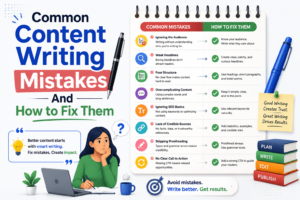
1. Writing Without a Clear Purpose
One of the biggest mistakes writers make is sitting down to write without knowing exactly what they want the piece to achieve. Is the goal to educate, entertain, persuade, or sell? Without a clear purpose, content tends to wander, mixing tones and ideas that don’t serve the reader. The fix: Before writing a single sentence, define the goal of the piece in one line. For example: “This post should help beginners understand how to start a podcast in under 10 steps.” Every paragraph you write afterward should serve that single purpose. If a sentence doesn’t support the goal, cut it.2. Ignoring the Target Audience
Writing for “everyone” usually means writing for no one. A common mistake is using language, examples, or depth of explanation that doesn’t match the actual reader. A beginner’s guide written with industry jargon will confuse new readers, while an advanced tutorial that over-explains basics will bore experienced ones. The fix: Create it simple for reader before you start. Ask yourself: What does this person already know? What are they struggling with? What tone will resonate with them — casual, professional, technical? Tailoring your writing to a specific audience instantly makes it more relevant and engaging.3. Weak or Generic Headlines
Your headline is the first and the impression you make. Many writers treat it as an afterthought, slapping on a bland, generic title once the content is done. Headlines like “Tips for Better Writing” or “How to Improve Your Blog” are forgettable and fail to create curiosity or urgency. The fix: Spend real time crafting your headline. Use numbers, specificity, or a clear benefit. Compare “Tips for Better Writing” to “9 Writing Habits That Instantly Make You Sound More Professional.” The second version tells readers exactly what they’ll gain, which increases the chance they’ll click and read.4. Burying the Lead
In journalism, “burying the lead” means hiding the most important information deep in the article instead of stating it upfront. Content writers often make this mistake by writing long introductions before the point. Online readers are impatient — if they don’t see value in the first few lines, they’ll leave. The fix: State your main point or promise within the first two or three sentences. Let readers know immediately what they’ll learn or gain from continuing. Save the storytelling and elaboration for after you’ve hooked them.5. Overusing Jargon and Complex Language
Some writers believe that complex vocabulary makes them sound more credible or intelligent. In reality, it often does the opposite — it alienates readers and makes content harder to digest. This is especially common in technical, financial, or academic writing, where jargon becomes a crutch instead of a clarity tool. The fix: Write like you’re explaining the topic to a smart friend who isn’t an expert in the field. Replace complicated words with simpler alternatives whenever possible. If you must use technical terms, briefly define them the first time they appear.6. Poor Structure and Formatting
Even brilliant ideas get lost if they’re presented as giant walls of text. Long, unbroken paragraphs are intimidating and hard to scan, especially on mobile devices where most readers now consume content. This is one of the most common and fixable mistakes in content writing. The fix: Break content into short paragraphs (2–4 sentences). Use subheadings to guide readers through sections. Incorporate bullet points and numbered lists where appropriate, and bold key phrases so skimmers can still grasp the main ideas.7. Neglecting SEO Fundamentals
Great content that nobody finds is a wasted effort. Many writers either ignore SEO entirely or go to the opposite extreme, stuffing keywords unnaturally into every sentence. Both approaches hurt performance — the first limits visibility, and the second makes content read awkwardly and can trigger search engine penalties. The fix: Use your target keyword naturally in the title, first paragraph, a subheading or two, and the meta description. Focus primarily on answering the reader’s question thoroughly; well-structured, helpful content tends to satisfy modern search algorithms far better than forced keyword density ever could.8. Failing to Edit and Proofread
Writing and editing are two different skills, and skipping the second one is a costly mistake. Typos, grammatical errors, and awkward phrasing chip away at your credibility, even if your ideas are solid. Readers — and clients — often judge the quality of your thinking by the quality of your prose. The fix: Always separate writing from editing. Finish a full draft, then step away before reviewing it with fresh eyes. Read your work to know the mistakes of awkward sentences, use grammar checking tools as a first pass, and if possible, have someone else review it before publishing.9. Lack of Originality
With so much content published every day, generic, recycled ideas struggle to stand out. A common mistake is writing content that simply repeats what’s already ranking on page one without adding a fresh angle, personal experience, or deeper insight. The fix: Before writing, research what’s already been published on the topic and then ask, “What can I add that isn’t already out there?” This could be a unique perspective, original data, a case study, a contrarian viewpoint, or simply clearer explanations than your competitors offer.10. Inconsistent Tone and Voice
Switching between formal and casual language, or shifting perspective from “you” to “we” to “one” within the same piece, creates a jarring reading experience. This mistake is especially common when content is written over multiple sessions or edited by different people without a style guide. The fix: Decide on a tone before writing — conversational, authoritative, witty, or formal — and stick with it throughout. If you’re part of a team, create a simple style guide covering voice, point of view, and formatting preferences to maintain consistency across all content.11. Not Including a Clear Call-to-Action
Content that informs but doesn’t guide the reader toward a next step is a missed opportunity. Whether it’s subscribing to a newsletter, reading a related post, or making a purchase, failing to include a clear call-to-action (CTA) leaves value on the table. The fix: End your content with a specific, low-friction next step. Instead of a vague “let us know what you think,” try something like “Download our free checklist to start applying these tips today.” Make the CTA relevant to the content topic so it feels like a natural next step, not an ad.12. Writing for Yourself Instead of the Reader
It’s easy to fall into the trap of writing what interests you rather than what your reader actually needs. This often shows up as excessive personal anecdotes, tangents, or self-indulgent explanations that don’t add value to the reader’s experience. The fix: Continuously ask, “Does this help my reader?” as you write. If a section is more about showcasing your knowledge than solving the reader’s problem, trim it down or cut it entirely. Content should always serve the audience first.13. Ignoring Data and Feedback
Some writers keep repeating the same mistakes because they never analyze how their content performs. Without reviewing metrics like bounce rate, time on page, or reader comments, it’s impossible to know what’s actually working. The fix: Regularly review analytics for published content. Notice which topics, headlines, and formats perform best, and use those insights to refine your future writing. Feedback — both from data and real readers — is one of the fastest ways to improve.14. Overpromising in the Title, Underdelivering in the Content
A flashy headline might get clicks, but if the actual content doesn’t deliver on that promise, readers feel misled and are unlikely to return. This mismatch between title and substance damages trust and increases bounce rates. The fix: Make sure your headline accurately reflects what the content delivers. If you promise “10 proven strategies,” make sure all ten are genuinely actionable and well-explained, not vague filler added just to hit a number.15. Neglecting Mobile Readability
With most web traffic coming from mobile devices, content that isn’t optimized for smaller screens creates a frustrating experience. Long paragraphs, tiny fonts, and cluttered formatting are especially punishing on mobile. The fix: Preview your content on a mobile device before publishing. Keep paragraphs short, use ample white space, and make sure subheadings and bullet points are easy to scan on a smaller screen.Final Thoughts
Great content writing isn’t about using fancy words or following every rule perfectly — it’s about clearly and effectively serving your reader. Most of the mistakes covered here boil down to a single root cause: losing sight of the audience’s needs in favor of ease, habit, or ego. The good news is that every one of these mistakes is fixable with awareness and practice. Start by auditing your own recent content against this list. Chances are, you’ll spot at least a few areas for improvement — and fixing even one or two of them can make a noticeable difference in how your content performs and resonates with readers. Good writing is a skill built through iteration, not instinct alone. The more consciously you edit out these common mistakes, the more naturally strong content will come to you over time.