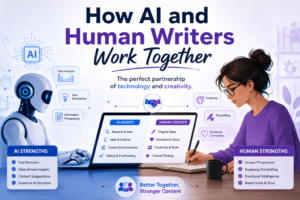
The conversation around artificial intelligence and writing has shifted dramatically over the past few years. What began as anxious speculation about robots replacing novelists and journalists has matured into something far more nuanced: a genuine partnership model where AI tools and human creativity complement rather than compete with each other. Understanding how AI and human writers work together isn’t just an academic exercise — it’s becoming essential knowledge for anyone who creates content, whether professionally or as a hobby.
This shift didn’t happen overnight. It emerged from thousands of writers, editors, marketers, and storytellers experimenting with AI tools in their daily workflows, discovering both the remarkable capabilities and the very real limitations of machine-generated text. What has emerged is a collaborative relationship that plays to the strengths of both parties while acknowledging what each does best.
The Changing Landscape of Content Creation
Not long ago, writing was an entirely solitary human endeavor. A writer sat with a blank page, wrestled with ideas, structured arguments, and painstakingly chose every word. Today, that blank page often isn’t blank at all — it might already contain an AI-generated outline, a rough first draft, or a handful of suggested angles waiting for human refinement.
This doesn’t mean human writers have become obsolete. Quite the opposite. As AI tools have become more accessible, the role of the human writer has evolved rather than diminished. Writers now often function as directors, editors, and curators of AI-generated content, guiding the process rather than performing every mechanical step themselves. This evolution has created a new kind of literacy — the ability to prompt effectively, evaluate AI output critically, and know exactly where human judgment needs to step in.
The result is a content creation ecosystem that moves faster than ever before, without necessarily sacrificing quality, provided the collaboration is managed thoughtfully.
What AI Brings to the Writing Process
AI writing tools excel at specific tasks that once consumed enormous amounts of a writer’s time and energy. Recognizing these strengths is the first step toward building an effective collaborative workflow.
Speed and Volume
AI can generate large volumes of text in seconds. For writers facing tight deadlines or needing to produce content at scale — think e-commerce product descriptions, social media captions, or first-pass article drafts — this speed advantage is transformative. What might have taken a human writer hours can be drafted by AI in moments, freeing up time for the more nuanced work of refinement and strategic thinking.
Overcoming Writer’s Block
Every writer knows the paralysis of staring at an empty document. AI tools have become remarkably effective at breaking through this barrier. By generating a rough starting point — even an imperfect one — AI gives human writers something to react to, edit, and improve. It’s often easier to fix bad writing than to create good writing from nothing, and AI provides that initial spark.
Research and Idea Generation
AI can quickly synthesize information, suggest angles a writer might not have considered, and surface counterarguments or supporting points for an essay or article. This doesn’t replace deep research, but it does accelerate the brainstorming phase considerably. A writer working on a complex topic can use AI to map out subtopics, generate questions worth exploring, or identify gaps in their initial argument.
Grammar, Style, and Consistency
Beyond generative capabilities, AI-powered editing tools catch grammatical errors, flag inconsistent tone, and suggest clearer phrasing. This kind of line-level polish used to require a dedicated copy editor; now it’s built into many writing workflows as an always-available layer of quality control.
Adapting Tone and Format
Need the same core message rewritten for a formal report, a casual blog post, and a punchy social media thread? AI handles these transformations quickly, allowing writers to repurpose content across channels without starting from scratch each time.
What Human Writers Bring That AI Cannot Replicate
Despite these strengths, AI-generated text has clear limitations — and this is precisely where human writers remain irreplaceable.
Lived Experience and Authenticity
AI has no life experience. It hasn’t fallen in love, grieved a loss, celebrated a hard-won achievement, or navigated the particular texture of a specific culture or community. When writing calls for genuine emotional resonance or personal storytelling, human writers draw on something AI simply cannot fabricate: authentic experience. Readers can often sense when writing lacks this dimension, even if they can’t articulate exactly why a piece feels hollow.
Judgment and Critical Thinking
AI generates text based on patterns in its training data, not genuine understanding or critical evaluation. It can produce plausible-sounding but factually incorrect information, miss important nuance, or fail to recognize when a claim needs more scrutiny. Human writers provide the judgment layer — fact-checking claims, questioning assumptions, and ensuring the final piece reflects genuine understanding rather than statistical pattern-matching.
Originality and Creative Risk-Taking
AI tends toward the statistically likely, which means its output can gravitate toward conventional phrasing and familiar structures. Genuinely original ideas, unexpected metaphors, and creative risks that break from convention still come predominantly from human imagination. The most memorable writing often takes chances that wouldn’t emerge from a system optimized to predict likely next words.
Ethical and Cultural Sensitivity
Understanding the ethical implications of a piece of writing, recognizing when a topic requires cultural sensitivity, or knowing how a particular community might receive certain language requires a depth of contextual understanding that AI can approximate but not fully replicate. Human writers serve as the final check against tone-deaf or harmful content slipping through.
Strategic Vision
Why is this piece being written? Who is it truly for? What should the reader feel or do after reading it? These strategic questions require an understanding of business goals, audience psychology, and brand voice that goes well beyond generating grammatically correct sentences. Human writers and editors set this vision; AI executes within it.
Models of Collaboration
The partnership between AI and human writers isn’t one-size-fits-all. Several distinct collaboration models have emerged, each suited to different types of projects.
AI as First Drafter
In this model, AI generates an initial draft based on a detailed brief, and the human writer then substantially revises it — restructuring arguments, adding personal insight, correcting inaccuracies, and injecting voice. This works well for content with a fairly standardized format, such as how-to guides or explainer articles.
AI as Research Assistant
Here, the human writer does the actual composing but leans on AI throughout the process to gather background information, generate outlines, or brainstorm angles. The writing itself remains entirely human-authored, but AI accelerates the preparatory stages.
AI as Editor
Some writers compose their own drafts from scratch and then use AI purely as an editing layer — checking for clarity, suggesting alternative phrasing, or flagging weak transitions. In this model, AI never generates original content; it refines what a human has already created.
Human as Curator
For high-volume content needs, some organizations have writers who primarily select, edit, and approve AI-generated drafts rather than write from scratch. This model prioritizes speed and scale, with human oversight ensuring quality and brand consistency remain intact.
Iterative Co-Creation
Perhaps the most dynamic model involves genuine back-and-forth between writer and AI: the human provides direction, AI generates options, the human refines or rejects those options, and the cycle repeats until the piece reaches its final form. This mirrors a collaborative relationship between two co-authors, albeit one where only one party possesses genuine understanding.
Challenges in the Collaboration
This partnership isn’t without friction. Several challenges deserve honest acknowledgment.
Over-reliance risk. Writers who lean too heavily on AI may see their own skills atrophy over time, particularly foundational skills like structuring an argument or finding a distinctive voice. Maintaining active engagement with the craft, rather than passive acceptance of AI output, is essential.
Homogenization of voice. Because AI models draw on similar training patterns, content produced with heavy AI involvement can start to sound generic or interchangeable across different writers and brands. Preserving a distinctive voice requires deliberate human intervention.
Accuracy and hallucination. AI systems can generate confident-sounding but incorrect information. Human writers must maintain rigorous fact-checking discipline rather than assuming AI-generated claims are automatically reliable.
Transparency and disclosure. Questions around whether and how to disclose AI involvement in published content remain an evolving area, with different publications, industries, and audiences holding different expectations.
Copyright and originality concerns. The legal and ethical landscape around AI-assisted content, including questions of authorship and intellectual property, continues to develop, and writers need to stay informed about best practices in their specific field.
Best Practices for Effective Collaboration
Writers who successfully integrate AI into their workflow tend to follow a few consistent principles.
First, they treat AI output as a starting point, never a finished product. Every piece of AI-generated text gets reviewed, questioned, and refined before publication. Second, they invest time in learning how to prompt effectively, understanding that the quality of AI output correlates strongly with the clarity and specificity of the input. Third, they maintain strong fact-checking habits, verifying any claims, statistics, or specific details that AI generates rather than accepting them at face value.
Successful collaborators also preserve deliberate space for their own voice and perspective, ensuring that even AI-assisted pieces carry a distinctly human signature. Finally, they stay curious and adaptable, recognizing that AI writing tools continue to evolve rapidly, and workflows that work well today may need adjustment as capabilities change.
Looking Ahead
The relationship between AI and human writers will likely continue evolving rather than settling into a fixed pattern. As AI tools become more sophisticated, the division of labor may shift further, with AI taking on increasingly complex drafting tasks while human writers focus even more intensely on strategy, judgment, and the irreplaceable elements of authentic storytelling.
What seems unlikely to change, however, is the fundamental value of human insight, experience, and ethical judgment in the writing process. AI can process patterns at extraordinary scale, but it cannot replace the lived experience, critical thinking, and creative risk-taking that define genuinely great writing. The writers who thrive in this new landscape won’t be those who reject AI tools outright, nor those who defer to them uncritically, but those who learn to wield them skillfully — treating AI as a powerful collaborator that amplifies human creativity rather than replacing it.
Conclusion
The story of AI and human writers isn’t one of competition or replacement — it’s one of collaboration, evolving skill sets, and a redefined creative process. AI brings speed, scale, and a tireless capacity for first drafts and research support. Human writers bring judgment, authenticity, originality, and ethical discernment that no algorithm can fully replicate. Together, when the partnership is managed thoughtfully, they produce writing that is faster to create and, at its best, no less meaningful, insightful, or human than writing produced entirely by hand. The future of writing isn’t human versus machine — it’s human and machine, working in tandem to tell better stories, explain complex ideas more clearly, and reach audiences more effectively than either could alone.